
The Inquiry · Modules 6 and 7
“When you don’t have a voice, your questions will remain unanswered”
CVF wasn’t a Core Participant in the Covid Inquiry’s ‘Care sector’ or ‘Test, trace and isolate’ modules. Lara Wong examines what the two recent reports have missed as a result.
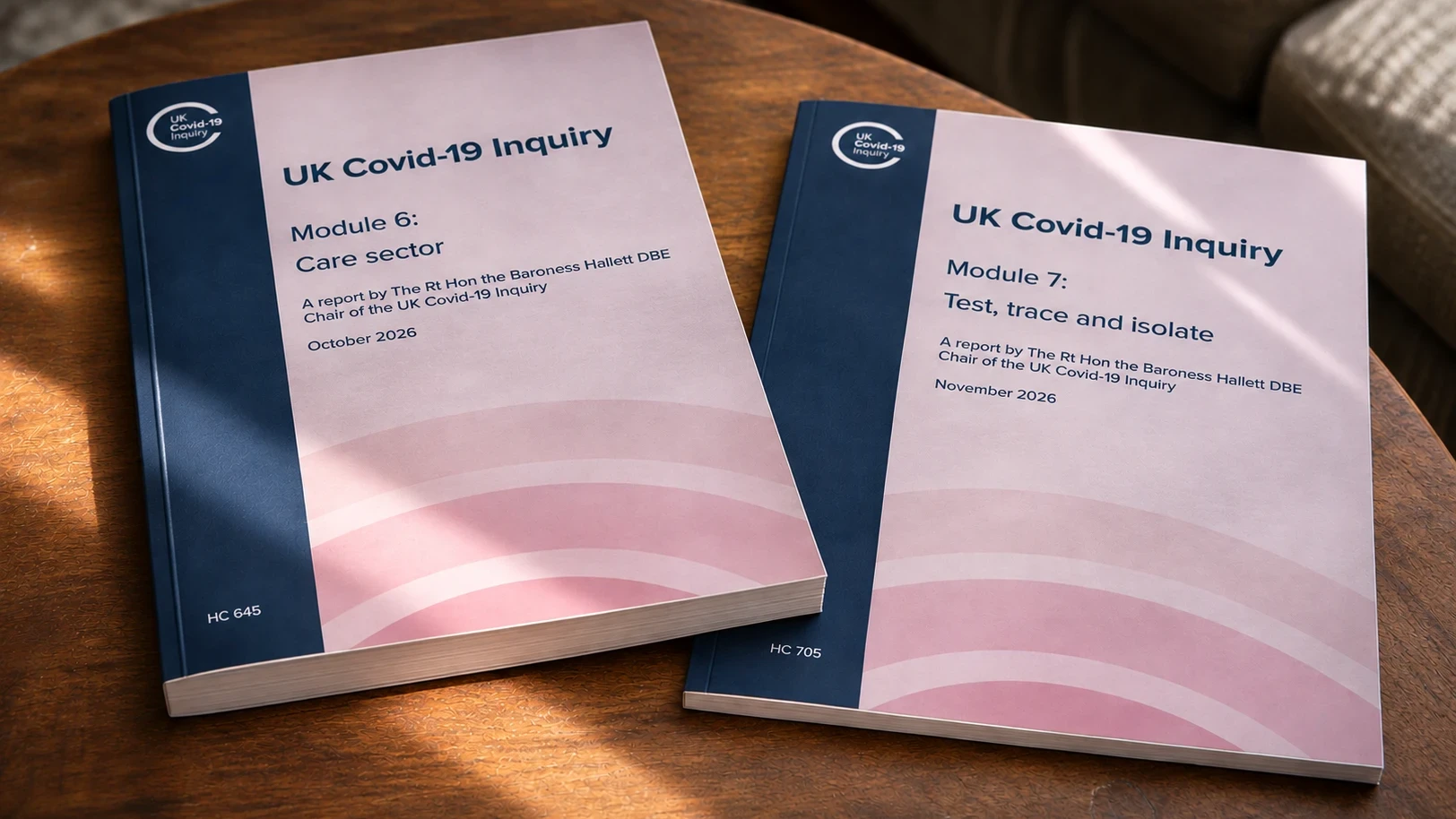
In the last two months, the UK Covid-19 Inquiry has published two reports that matter a great deal to Clinically Vulnerable people: the Care Sector report (Module 6) on 20th October, and the Test, Trace and Isolate report (Module 7) on 19th November. I have spent a lot of time reading through both of them. Unfortunately CVF wasn’t a Core Participant in either, for very different reasons, but by reading them side by side I can now see what that cost us all.
Module 6: Care sector
CVF wasn’t a Core Participant in Module 6 because we didn’t apply to be one. Our members don’t live in care homes, and we felt that CVF should not speak for groups that weren’t represented within our membership. Module 6 was focused on a different population, most of whom aren’t on social media, and whom we therefore could never expect to engage with directly.
The uncomfortable truth is that care homes are obviously full of Clinically Vulnerable people. As a population they are more concentrated in care homes than anywhere else in the country. So, if you were trying to pick the buildings where our arguments about indoor air quality and infection prevention matter most, you might very well choose to start there: a high-risk environment filled with a high-risk population.
But Core Participant status isn’t allocated based on general interest. It is a formal role, and the Inquiry will only grant it to those with a direct stake in what’s being examined. Sharing a vulnerability isn’t the same as sharing a pandemic experience. The bereaved families’ groups, the sector bodies and the unions had direct knowledge of the homes and the people who worked in them. Module 6 heard from 57 witnesses over five weeks, and reading the report, that work was done properly without us.
I know that our decision was the right one for us. However, I am very disappointed that our issues are missing from the report.
When I look through a report, I always start by searching the text for keywords, because I am keen to read the outcomes on certain topics first. For Module 6, these are the things that immediately jumped out at me:
The word “airborne” doesn’t appear even once.
There is nothing on “FFP2”, “FFP3”, “respiratory protective equipment”, or “fit-testing”.
The only masks discussed are the fluid-resistant surgical masks that care workers were handed in March 2020. Separately, the report records care workers improvising PPE out of bin bags and festival ponchos because they could not get hold of any.
“Ventilation” appears nine times. But the focus was on opening a window, with a caveat about not freezing elderly residents.
“HEPA” appears just once, in a passing note that in England providers couldn’t spend Infection Control Fund money on air filtration until the end of 2021. Which, on reflection, is a remarkable thing to identify without making any recommendations about it.
There’s a line early in chapter 3 saying that whatever the route of transmission, infection control measures are what matter. I understand why it’s there, and as a statement about the importance of infection prevention and control it is correct. But that statement seems to close a question which the report then never returns to. We know that the mode of transmission should determine the measures you take to reduce infections: the guidance, and the protection needed in the building and for each individual. But if the identified route is wrong, then everything downstream of that decision will be wrong too.
A few pages later the report quotes the healthcare guidance of 13th March 2020, which described Covid as spreading mainly through respiratory droplets and contaminated surfaces, and then it stops. Of course, that premise was not unique to the care sector, and the NHS was using it too, but at least the Inquiry’s Healthcare report did consider the impact in hospitals. Shockingly, nobody seems to have done the same for care homes. For some reason, the premise and its consequences aren’t examined for this high-risk environment, and so the care workforce, unlike their NHS colleagues, never even had a pathway to appropriate respiratory protection.
The Healthcare report found that guidance for hospitals should have emphasised ventilation far earlier than it did, and that the reason it didn’t was likely the belief among members of the UK IPC Cell that Covid wasn’t ordinarily spread by aerosols. Professor Beggs told the Inquiry that ventilation is used as a measure to reduce airborne spread, so it would be incoherent to insist that ventilation matters while maintaining that airborne transmission doesn’t happen. In the Healthcare report, published on 19th March 2026, the word “airborne” appeared 38 times. In the Care Sector report, published seven months later, it doesn’t even appear once. Same Inquiry, same Chair. Yet the findings about airborne transmission and ventilation that featured so prominently in the Healthcare report appear not to have been carried across into the examination of care homes.
When Professor Sir Jonathan Van-Tam gave evidence about what a real protective ring would have required, he identified three routes in: admissions, visitors and staff. The report follows the same framing. Clearly, all three focus on the people who bring infections in with them. Yet the route of transmission itself, through the air, is not considered. So there is very little sense that the report has looked at what happened once the virus was over the threshold, or how to reduce those risks.
Module 7: Test, trace and isolate
Module 7 was a very different story, because we did apply to be a Core Participant.
Testing and isolation mattered to our members more than almost anyone. A test would determine whether a grandchild could visit at Christmas, or whether a child coming home from school with symptoms might be carrying an infection to a high-risk parent having cancer treatment. For people at the highest risk, a positive test is also the only way to get antiviral treatment, which needs to be started within five days of symptoms.
We applied in April 2024, and in May 2024 the Inquiry rejected us. Instead it asked us for a written statement, which we sent in April 2025: 53 pages and 45 exhibits about what Clinically Vulnerable people experienced across the UK. A written statement is not at all the same thing as being a Core Participant and part of the Inquiry process. We couldn’t see the evidence as it came in, put forward questions for witnesses, or make opening and closing statements, and we weren’t called to give evidence in person.
The report does use our statement, and I am glad of that. It opens with the words of one of our members, Jane: “Most of our neighbours turned off test and trace as they saw it as punishment and if they were pinged it would stop them from being able to go out.” It takes our point that workers often felt “compelled to continue working” because the financial support was not enough. And it accepts that without lateral flow testing, undetected infections would have increased “the risks for those who were clinically vulnerable”.
Then I did my keyword search again. These are the things that immediately jumped out at me:
The words “priority PCR” don’t appear even once.
“Immunocompromised” and “immunosuppressed” don’t appear either.
“Higher risk” appears, but only about travel.
The report makes nine recommendations, and not one of them mentions Clinically Vulnerable people.
It notes that free lateral flow tests ended for most people in March and April 2022, while “targeted groups remained eligible”, and leaves it there. Nobody seems to have asked what that meant for the people living with them. Partners, children and carers of the most vulnerable people were never eligible, even though testing at home was one of the few ways a family could protect someone.
The priority PCR tests that were posted to around 1.3 million people at the highest risk aren’t examined. Neither are the used kits that weren’t replaced, the calls passed between 111 and 119, or the positive results on pharmacy tests that couldn’t be reported, so that people who qualified for treatment couldn’t get it. All of this was in our statement. Testing and treatment were treated as separate questions, in different modules of the Inquiry. That is exactly the kind of crack we warned the Inquiry about, because we didn’t want our issues to fall down it. I’m afraid that in this case they have.
People who were Clinically Extremely Vulnerable were told to use a separate room and, if they could, a separate bathroom when someone at home was infected. In small homes, and for people who were themselves carers, that was often impossible. The only time the report looks at a household with a vulnerable member is a Welsh offer of temporary accommodation.
And when the legal duty to self-isolate ended in England in February 2022, and contact tracing was wound down across the UK that year, the report records the dates. It doesn’t examine what those changes meant for people who were still at the highest risk, and those who continue to take precautions today.
Would it have been different?
I can’t know for certain. Module 6 was a packed module that rightly had to deal with the NHS discharge policy, PPE supply, and families who weren’t allowed to visit their dying parents. Those issues deserved the attention they received. I’m not suggesting we could have walked in and changed everything.
But I have seen what happens when we are in the room. Our work helped secure changes to the terms of reference and the expert evidence in the Children and Young People’s module, including making sure it covered children in Clinically Vulnerable families. In Module 4, where we were Core Participants, Baroness Hallett accepted “without reservation” that protecting immunocompromised people, including through prophylactic drugs, “must be a priority when preparing for the next pandemic”. Yet seven months later, in Module 7, which by rights should have covered priority testing for people at the highest risk, the word “immunocompromised” doesn’t appear at all.
An Inquiry this size, covering the whole of the UK across several years, does have to be split up, and administratively that is the only reasonable option. The problem remains that the pandemic wasn’t split up. Covid did not behave differently because someone was in a care home rather than a hospital ward, or isolating at home rather than in hospital. The public might reasonably expect that if the Inquiry establishes something fundamental in one report, it would have a knock-on effect in later modules. When it doesn’t, the reason probably isn’t that somebody made an active decision to leave those lessons out. It seems the Inquiry works in the same kind of silos it criticised in government decision-making in Module 2. And ironically, if nobody is there to raise a question, there is nothing for the Inquiry to consider.
So the part I regret is not our decision on Module 6, which, given everything else, I would make again. It is that airborne transmission was not addressed. And in Module 7, where we tried to be heard, the people who relied on test, trace and isolate the most were heard only on paper, and only on the points the report’s authors chose to use.
What happens now
The Module 7 report does give government a chance to put some of this right. It calls for a new UK-wide test, trace and isolate system that is “accessible to all population groups”, and for data to “assess differing impacts across groups”. Clinically Vulnerable people, and the people they live with, must be one of those groups from the start. Support to self-isolate must cover whole households. And testing must be linked to treatment, so that anyone eligible for antivirals can test at home, report a positive result and be treated quickly.
We will continue to press for the Inquiry to connect its findings across modules, to examine what was understood about airborne transmission, and to consider whether the protections available to Clinically Vulnerable people were adequate.
Nobody experienced the pandemic in separate, distinct modules.
And sadly, when you don’t have a voice, your questions will remain unanswered.